How it works
Drop the documents you already have — an audit expert does the rest.
Complete the form and upload your documents
Your name, email, company, and the carrier's audit worksheet plus the audit bill. Under five minutes, no account. Files go straight into private, encrypted storage.
Free expert review — 24 hours
An audit expert reads the actual worksheet — the class codes, the payroll basis, what was added and what was excluded — and tells you whether there is a valid dispute.
A straight answer by email
Check your spam. Either the audit looks correct and there is nothing worth disputing — you're done, no charge — or we found errors, with an estimated return premium and quote.
Your call, with numbers in hand
To move forward with our full analysis, simply reply to that email. We'll send a payment link to complete the full review. Every finding and the analysis behind it comes to you in writing, ready to send straight to your carrier. Any questions, just reply.
Here's a Sample Report
From Our Free Preliminary Review
Here's a real preliminary finding report, shared with our client's permission with identifying details removed. This is our free no obligation review — we tell you whether your audit is worth disputing and what we estimate is at stake.
Email us to request a sample of our full paid analysis →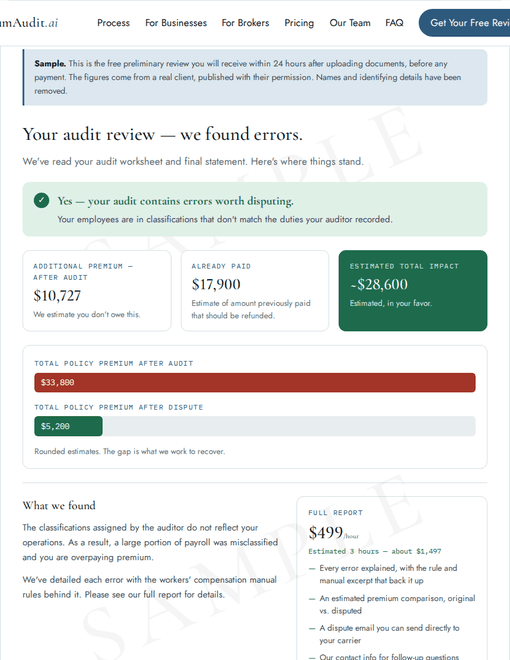 Read the sample preliminary review →
What we look for
Common errors we find.
Standard Exception Codes
Clerical (8810), Outside Salespersons (8742) and Telecommuter Employees (8871) are standard exception classifications. Classification decisions frequently rest on assumptions about a title rather than on what the employee actually does — the same "project manager" title can mean an office role at one firm and a hard-hat, on-site supervisory role at another. When an auditor sweeps these employees into the governing construction or manufacturing class, payroll that should rate at pennies rates at dollars. This is the single most common finding and often the largest. We ensure that employees who qualify are coded there instead of higher-rated classifications.
Governing Classification
Nobody reads the manual. It runs hundreds of pages, and the codes and exceptions vary by state — brokers and underwriters aren't experts in it either, and auditors often simply use the code already on the policy. The governing class is one judgment call about a company's overall operations, two codes a page apart can differ 3:1 on rate, and a wrong code can carry forward for years. We ensure the governing code is correct and let you know if a lower-rated code better fits the work actually performed. We also check whether manual rules allow payroll to be divided across codes instead of applying one high-rate code to the whole operation.
Payroll Basis & Exclusions
Tips, Section 125 contributions, severance pay, state-specific exclusions, and wage caps all reduce the payroll base, and they often get missed. Each is a deduction the auditor is supposed to apply, not a concession the employer has to request. We check for all applicable deductions in every state. An audit that misses the exclusions overstates the payroll base — and every premium dollar built on it.
Subcontractors
Subcontractor payments picked up as payroll when certificates of insurance were on file, or charged at the wrong basis. A common source of surprise additional premium. Frequently the coverage existed the whole time. On a subcontractor-heavy account this is the difference between a routine audit and a five-figure bill.
Ready when you are.
The free review takes you under five minutes to start.